
Source: Common clinical reference ranges (2026).
One in seven men will face a prostate cancer diagnosis in their lifetime, yet a single lab value often causes more questions than answers.
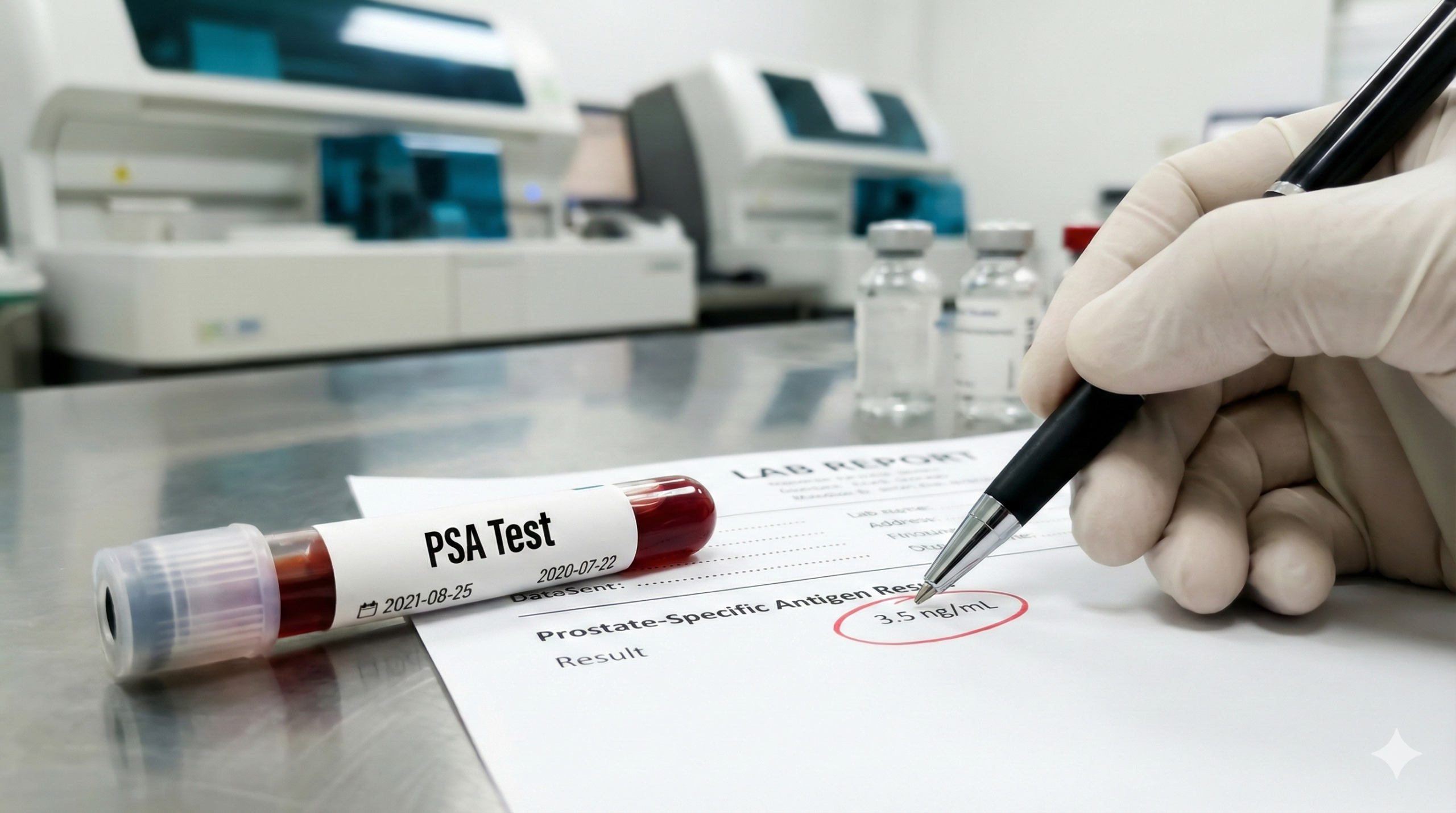
Prostate-specific antigen is a protein made by the prostate gland and measured with a simple blood test reported in ng/mL.
That number is a screening clue, not a diagnosis. A raised value can reflect benign causes, recent activity, or early cancer risk.
Clinicians usually compare values over time and set an individual baseline. Repeat testing and a review by a doctor make the result meaningful.
This article will explain common ranges by age, factors that can temporarily raise PSA, and clear questions to ask at a follow-up visit. The goal is practical: reduce avoidable alarms, know when to repeat a test, and see PSA as one part of an overall prostate health picture.
Key Takeaways
- PSA is a blood marker made by the prostate and measured in ng/mL.
- A single result is a screening tool, not a diagnosis of cancer.
- Values can change for noncancer reasons; repeat tests help clarify risk.
- Age and personal baseline matter for interpreting results.
- Discuss trends and next steps with a clinician before assuming outcomes.
What PSA Is and What the PSA Blood Test Measures
A PSA result shows how much prostate-produced protein is circulating in the blood. This protein, called prostate-specific antigen, comes from prostate cells and can appear in small amounts in many men.
PSA explained in plain language
PSA is a protein made by prostate tissue. Healthy cells and abnormal cells both release it, so a higher measurement is a warning sign, not a diagnosis.
How results are reported and why values change
U.S. labs report PSA in ng/mL (nanograms per milliliter). That unit makes it easy to compare tests over time and between labs.
- PSA can rise with more prostate tissue, such as benign prostatic hyperplasia.
- Irritation, inflammation, or infection can increase PSA temporarily.
- Prostate cancer can also raise PSA, but it is not the only cause.
Why testing is used for screening and monitoring
Clinicians use PSA testing both to screen for early issues and to monitor trends year to year. Repeat measures help establish a personal baseline and show whether a level is stable or changing.
“PSA is sensitive but not specific: it flags when more checks are prudent.”
| Use | What it shows | Why repeat tests matter |
|---|---|---|
| Screening | Possible early prostate changes | Detects shifts before symptoms occur |
| Monitoring | Trend of PSA over time | Baseline helps interpret new results |
| Follow-up | Response after treatment or infection | Confirms decline or rise after intervention |
Understanding Your PSA Levels: What Do The Numbers Really Mean? Interpreting Results Without Jumping to Conclusions
One lab result is only a snapshot and often needs context to be useful. Short-term changes happen from benign causes, recent activity, or infection. Clinicians look for patterns before suggesting invasive steps.
Why a single number rarely tells the whole story
psa can fluctuate. A single elevated reading prompts repeat testing, a focused history, and a physical exam. Stable values over time usually lead to routine follow-up.
Common result bands clinicians use
- Below 1 ng/mL: generally benign for most men.
- 1–3 ng/mL: often within a safe range; monitor trends.
- >3 ng/mL: may prompt further evaluation based on personal risk.
- 4–10 ng/mL: considered borderline; repeat tests and review factors.
- >10 ng/mL: well above typical ranges and usually leads to expedited evaluation.
Why trends, age, and family history matter
Baseline values and psa velocity (year-to-year change) often reveal more than a single level. A doctor combines age, family history, and other risk factors before discussing prostate cancer testing or imaging.
“Trends and risk context guide decisions more than any lone test result.”
Normal PSA Ranges and How They Change With Age
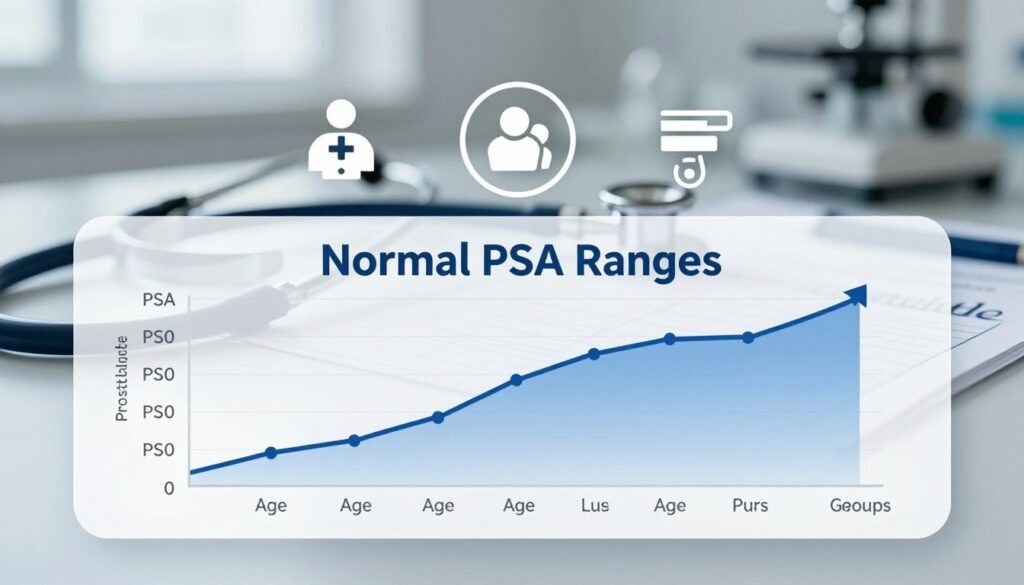
Age-related prostate growth usually causes small PSA increases over years, which is often normal.
Why this happens: As men get older, prostate tissue often enlarges. More tissue can release more PSA into the blood, so a mild rise in levels over time can reflect anatomy rather than cancer.
| Age Group | Normal PSA Range (ng/mL) |
|---|---|
| 40 to 49 years | 0 to 2.5 |
| 50 to 59 years | 0 to 3.5 |
| 60 to 69 years | 0 to 4.5 |
| 70 to 79 years | 0 to 6.5 |
How “normal” varies
There is no single normal level for everyone. A value that is typical for one man may be unusual for a younger man with a low baseline.
When repeat screening is commonly considered
Clinicians often use intervals based on prior results and risk. For example, men at higher risk may repeat testing every 1–2 years when levels sit between 1–3 ng/mL, or every 2–4 years if levels are below 1 ng/mL.
Who may discuss screening earlier
Shared decision-making guidance in the U.S. commonly targets average-risk men aged 55–69 for routine screening. Black/African American men and those with a strong family history may discuss testing earlier, often in their 40s, so a baseline helps future comparisons.
“Screening choices should be personalized with a doctor, using age, health, family history, and risk to guide timing.”
Common Non-Cancer Causes of Elevated PSA Levels

Many benign factors can push a psa value higher for a short time. Clinicians review recent events and health issues before assuming a diagnosis of prostate cancer.
Benign prostatic hyperplasia (BPH)
BPH, or prostate enlargement, raises psa because more prostate tissue makes more antigen. When BPH is likely, doctors often monitor trends rather than rush to invasive tests.
Infection and inflammation
Prostatitis and urinary tract infection can cause both urinary symptoms and a temporarily elevated psa. Treating infection then repeating the psa test usually clarifies the cause.
Activity, procedures, and medications
Recent ejaculation, vigorous exercise—especially long bike rides—and recent prostate procedures, including a prostate biopsy, can raise readings. Some drugs and obesity affect values too. Always tell the doctor about recent tests, procedures, and medications.
How to prepare
Avoid ejaculation for about 48 hours and skip heavy cycling or vigorous exercise for a couple of days before a psa test. Postpone testing during a known UTI or prostatitis episode and bring a medication list to the visit.
“When a test is high, repeat testing under consistent conditions often resolves uncertainty.”
| Cause | Effect on PSA | Usual action |
|---|---|---|
| Benign prostatic hyperplasia (BPH) | Moderate, chronic rise | Monitor trends; consider imaging if progressive |
| Prostatitis or UTI | Marked, temporary rise | Treat infection; repeat test after recovery |
| Recent ejaculation/exercise | Short-term, mild rise | Repeat test after 48–72 hours abstinence |
| Prostate procedures (biopsy) | Significant, prolonged rise | Delay routine testing for weeks; note procedure date |
PSA Screening Is a Tool, Not a Diagnosis
A screening test can raise a question; clinicians use other clues to answer it. A psa result flags possible concern but cannot confirm or rule out prostate cancer alone.
What a psa test can and cannot tell clinicians about cancer risk
The psa test helps identify men who may need more checks. It indicates probability, not a final diagnosis.
Clinicians pair test results with age, family history, and symptoms before advising next steps.
How psa is often paired with a digital rectal exam for context
A digital rectal exam adds a physical finding to blood results. Together they improve risk assessment and guide a doctor toward fitting evaluation.
Why borderline results may lead to more evaluation, not immediate conclusions
When values sit in a borderline range, common actions include repeat testing under consistent conditions, symptom review, and medication checks.
If concern persists, clinicians may discuss imaging or a biopsy. Decisions are personalized and not automatic.
“Screening is an invitation to investigate, not a verdict.”
| Finding | Typical next step | Purpose |
|---|---|---|
| Low/normal psa | Routine follow-up | Maintain baseline and monitor change |
| Borderline (4–10) | Repeat test, DRE, consider imaging | Clarify risk before biopsy |
| Persistently high | Discuss biopsy and further evaluation | Assess for cancer and extent |
How to Support Healthy PSA Levels Naturally
If your doctor confirms that your elevated PSA is due to benign factors like inflammation or BPH (and not cancer), lifestyle changes can make a big difference.
Eating an anti-inflammatory diet and using targeted supplements can help reduce prostate swelling. Key ingredients to look for include:
- Saw Palmetto: Known to inhibit enzymes that contribute to prostate growth.
- Beta-Sitosterol: Supports better urinary flow.
- Antioxidants: Like Lycopene and Quercetin to fight inflammation.
Many men use comprehensive formulas like ProstaLite, which combines these potent nutrients into one daily supplement designed to support prostate comfort and healthy PSA markers.
Medical References
The information in this article is based on guidance and educational resources from trusted medical organizations, including:
- Mayo Clinic – Prostate-specific antigen (PSA) test
- Cleveland Clinic – Prostate-Specific Antigen (PSA) Test
- National Cancer Institute (NCI) – Prostate-Specific Antigen (PSA) Test Fact Sheet
- NHS – PSA testing
Conclusion
A single blood test offers a useful clue, but context makes it actionable.
PSA is a protein made by prostate cells and measured in blood. PSA levels are best read alongside age, prostate size, and prior values rather than as a lone answer.
Many benign conditions can raise a PSA level temporarily. Avoid short-term triggers before a test and repeat testing or monitoring across years often gives clearer results.
Screening guides next steps: repeat testing, closer surveillance, or further evaluation with a doctor. If prostate cancer is found, management ranges from active surveillance to treatment based on risk and patient preference.
Practical next step: talk with a clinician who can interpret results in context and recommend appropriate care.
Medical disclaimer: This article is for educational purposes only and does not provide medical advice, diagnosis, or treatment. Consult a licensed healthcare professional for personalized guidance about PSA results and next steps.
FAQ
What does a PSA blood test measure?
Can a single PSA number diagnose prostate cancer?
How do doctors interpret different PSA ranges?
Why do PSA levels tend to rise with age?
What is PSA velocity and why does it matter?
Which non-cancer conditions can raise PSA?
How should a man prepare for a PSA test to avoid false alarms?
When is repeat PSA testing appropriate?
What happens if PSA is elevated but the DRE is normal?
Does an elevated PSA always mean immediate treatment is needed?
How do family history and race change screening recommendations?
Can medications affect PSA results?
What are the next steps if a biopsy confirms cancer?
How often should men of average risk get screened?
Are urine tests or imaging alternatives to PSA?

“Abdullah is a dedicated health researcher specialized in urological wellness and prostate health. With years of experience in analyzing clinical studies, he provides evidence-based guidance to help men lead healthier lives.”
