
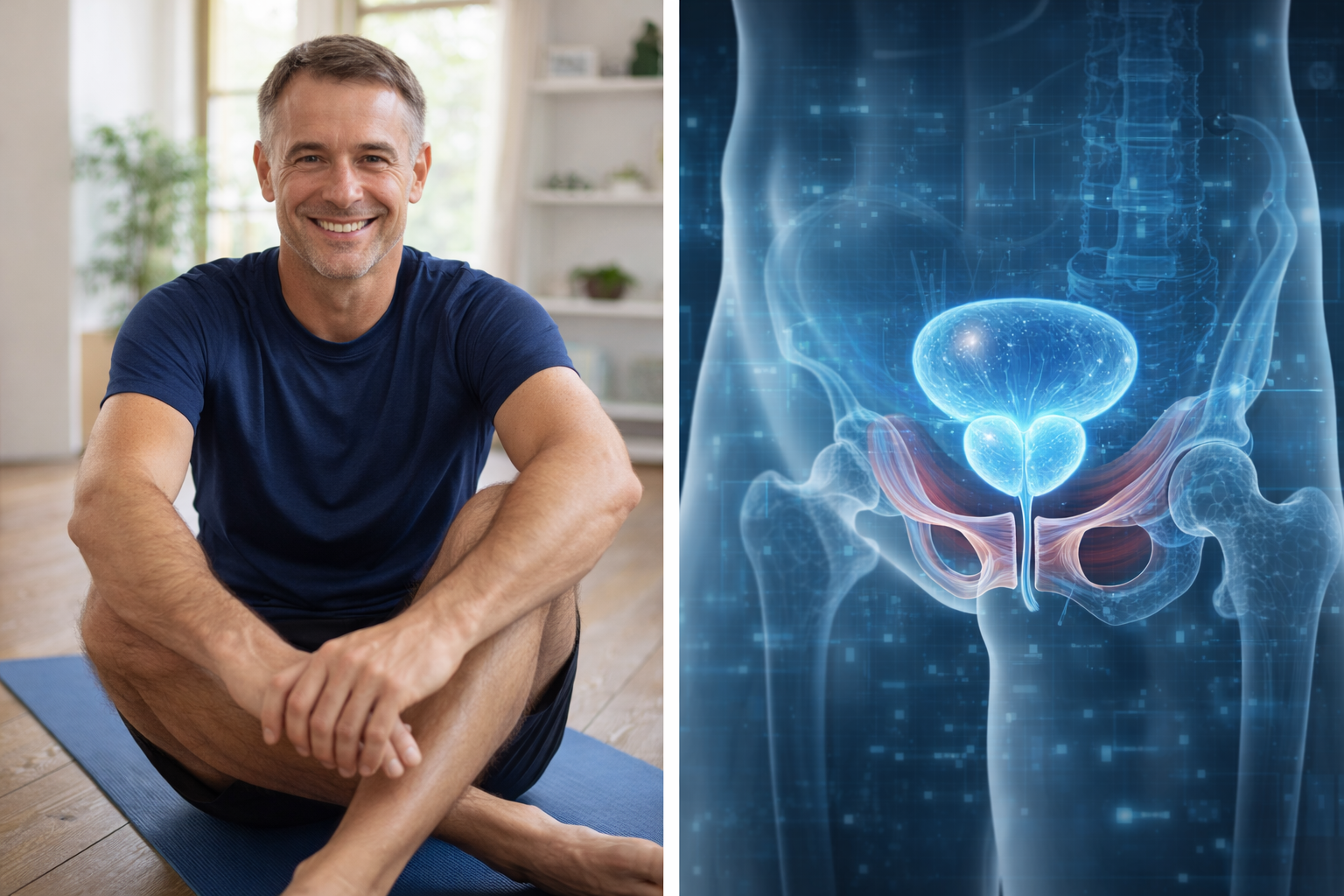
You wake up for the third time tonight. You stand over the toilet, waiting. You push, you strain, but the flow is weak, hesitant, and frustrating. You finish, but you don’t feel “empty.”
If this sounds familiar, you are likely one of the millions of men dealing with BPH (Benign Prostatic Hyperplasia).
Most men think the only solutions are surgery or lifelong medication with harsh side effects. But what if there was a way to improve your symptoms simply by “working out” a muscle you can’t even see?
Welcome to the world of Kegel exercises for enlarged prostate.
While often associated with women, Kegel exercises are arguably more critical for men. Why? Because the prostate gland sits directly on top of the pelvic floor muscles. When these muscles are weak, your bladder control crumbles. When they are strong, they act like a “support beam,” helping you regain control over your flow and your life.
In this comprehensive guide, we are going to walk you through 8 scientifically backed exercises designed specifically for men with BPH. No gym required. No equipment needed.
Why Kegels Are the “Secret Weapon” Against BPH
Before we jump into the routine, you need to understand the mechanics. An enlarged prostate squeezes the urethra (the tube urine flows through). This makes it hard for the bladder to push urine out.
So, how do exercises help?
Performing Kegel exercises for enlarged prostate doesn’t shrink the gland itself (we will talk about what does that later), but it strengthens the external sphincter muscle. This helps in three major ways:
- Better Bladder Control: Reduces that “sudden urge” to go.
- Reduced Dribbling: Helps empty the urethra completely after urination.
- Improved Blood Flow: Exercise brings fresh, oxygenated blood to the pelvic area, which helps reduce chronic inflammation.
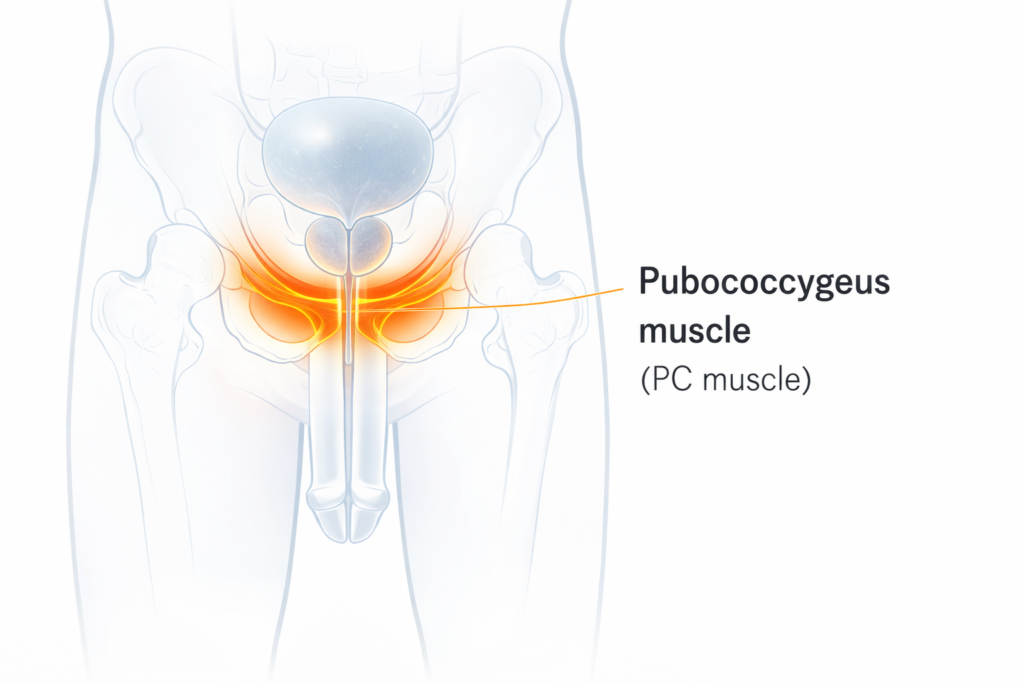
Step 0: Finding Your “PC Muscle” (The Stop Test)
You cannot train a muscle if you cannot feel it. Many men make the mistake of squeezing their buttocks or abs instead of the pelvic floor.
Here is the “Stop Test” to find the right muscle:
- Next time you are urinating, try to stop the flow mid-stream.
- Don’t use your hands. Don’t hold your breath. Just use your muscles.
- That muscle you just tightened? That is your Pubococcygeus (PC) muscle. That is your target.
Warning: Do not use this test as an exercise. Stopping urine frequently can cause infections. Use it only once to locate the muscle.
The 8 Best Kegel Exercises for Enlarged Prostate Relief
Ready to reclaim your bladder control? Perform this routine 3 times a week for best results.
1. The “Lying Down” Basic Squeeze
This is the starting point. Gravity is neutral here, making it easier to focus.
- How to do it: Lie on your back with knees bent and feet flat on the floor.
- The Move: Contract your PC muscle (like you are holding in gas). Hold for 3 seconds. Relax for 3 seconds.
- Reps: 10 repetitions.
2. The “Standing Guard”
Once you master lying down, do it standing up. This mimics real-life situations.
- How to do it: Stand with feet shoulder-width apart.
- The Move: Tighten the pelvic floor. Imagine you are lifting your testicles upwards. Hold for 5 seconds.
- Reps: 10 repetitions.
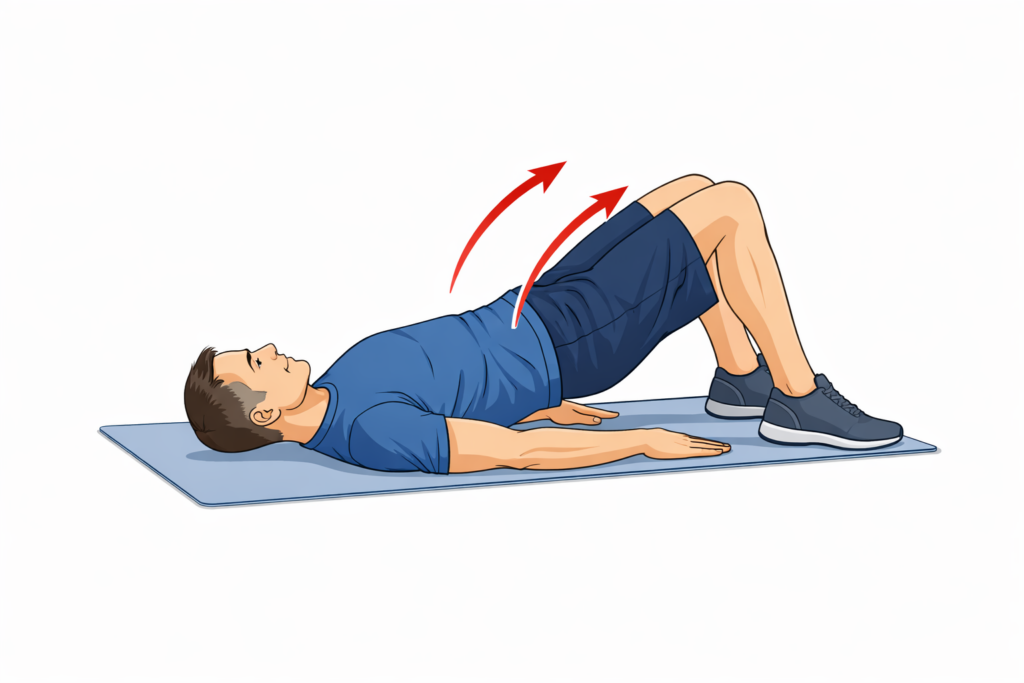
3. The Glute Bridge (Compound Movement)
This targets the pelvic floor along with the glutes and lower back.
- How to do it: Lie on your back, knees bent. Lift your hips toward the ceiling until your body forms a straight line.
- The Move: At the top, squeeze your pelvic floor hard. Hold for 3 seconds, then lower slowly.
- Reps: 12 repetitions.
4. The “Elevator” Technique
This improves control, not just strength.
- How to do it: Imagine your pelvic floor is an elevator.
- The Move: Slowly contract to “Floor 1,” then tighter to “Floor 2,” then max tightness at “Floor 3.” Then slowly release back down floor by floor.
- Reps: 5 slow cycles.
5. Rapid Fire Kegels (Fast Twitch)
This trains the muscle to react quickly to sudden urges (like when you cough or sneeze).
- How to do it: Squeeze and release as fast as you can.
- The Move: Squeeze-Release-Squeeze-Release. Do not hold.
- Reps: 20 fast reps.
6. The Deep Squat Hold
Squats increase intra-abdominal pressure, forcing the pelvic floor to work harder to stabilize.
- How to do it: Stand with feet wide. Lower into a squat (as deep as comfortable).
- The Move: Hold the squat position. While holding, perform a slow Kegel squeeze for 5 seconds.
- Reps: 8 squats.
7. The “Walking” Kegel
The goal is to integrate this into daily life.
- How to do it: While walking, try to hold a light Kegel squeeze (about 30% intensity).
- The Move: Hold it while you take 10 steps. Relax for 10 steps.
- Duration: Do this for 2 minutes during your daily walk.
8. The “Reverse Kegel” (Deep Breathing Relax)
This is vital for BPH patients. sometimes the problem isn’t weakness, but tension. An overly tight pelvic floor can constrict the urethra even more.
- How to do it: Lie down or sit comfortably. Take a deep breath into your belly.
- The Move: As you inhale, focus on pushing the pelvic floor down and out (relaxing it completely), as if you are trying to urinate.
- Reps: 10 deep breaths.
📺 Watch: Best Exercises for Enlarged Prostate Relief
Sometimes seeing is believing. Check out this helpful demonstration to ensure your form is perfect:
⚠️ Warning: Exercises to Avoid with Enlarged Prostate
Not all exercises are your friend. If you have BPH, high-impact activities can irritate the pelvic floor and worsen symptoms. Try to avoid:
- Heavy Cycling: Standard bicycle seats put immense pressure on the perineum (the area between the scrotum and anus), cutting off blood flow to the prostate.
- Heavy Weightlifting (without proper breathing): Straining to lift heavy weights increases abdominal pressure, which pushes down on the bladder.
- Sit-ups / Crunches: Traditional sit-ups can put unnecessary strain on the pelvic floor. Opt for planks instead.
💪 You Trained the Muscle… Now Shrink the Gland
This is the most important part of this guide.
Kegel exercises strengthen the “pump” (the muscles), but they do not fix the “blockage” (the enlarged prostate gland itself).
Imagine a garden hose with a kink in it. You can increase the water pressure (Kegels), but unless you un-kink the hose (shrink the prostate), you will always struggle.
To truly solve the problem, you need to address the root cause: DHT and Inflammation.
This is why we recommend pairing your exercises with ProstaLite. It is an advanced natural formula designed to support healthy prostate size.
- ✅ Beta-Sitosterol: Helps improve urinary flow.
- ✅ Anti-Inflammatory Complex: Complements your pelvic floor work.
- ✅ Nighttime Relief: Sleep through the night again.
👉 Click Here to See How ProstaLite Works
Frequently Asked Questions
How long does it take for Kegel exercises to work for enlarged prostate?
Muscle building takes time. Most men report noticing a difference in bladder control after 4 to 6 weeks of consistent daily practice. However, combining exercises with dietary changes (like avoiding caffeine) and supplements can speed up relief.
Can Kegels make prostate symptoms worse?
If done incorrectly (over-tensing without relaxing), yes. This is why Exercise #8 (The Reverse Kegel) is so important. You must learn to relax the pelvic floor as well as contract it to ensure the urethra can open fully.
Are there any specific yoga poses for prostate?
Yes. Poses like “Cobbler’s Pose” (Baddha Konasana) and “Reclining Hero” (Supta Virasana) are excellent for opening the pelvic region and reducing tension around the prostate gland.
Final Thoughts: Consistency is Key
Treat your pelvic floor like any other muscle group. You wouldn’t go to the gym once and expect big biceps. The same applies to Kegel exercises for enlarged prostate.
Start with the 8 exercises listed above. Be patient with your body. And remember, exercises are just one pillar of prostate health. For the best defense, combine physical training with the nutritional support of prostate-friendly foods and supplements like ProstaLite.
Here is to a stronger flow and better sleep!
Scientific References
- “Pelvic floor muscle training for men with lower urinary tract symptoms” – Cochrane Library.
- “Kegel exercises for men: Understand the benefits” – Mayo Clinic.
- “Physical activity and benign prostatic hyperplasia” – Harvard Health Publishing.

“Abdullah is a dedicated health researcher specialized in urological wellness and prostate health. With years of experience in analyzing clinical studies, he provides evidence-based guidance to help men lead healthier lives.”
